|
Status: Live
 Refreshing in 30 seconds...
 

McMurdo Station Weather Fetching Weather Data...
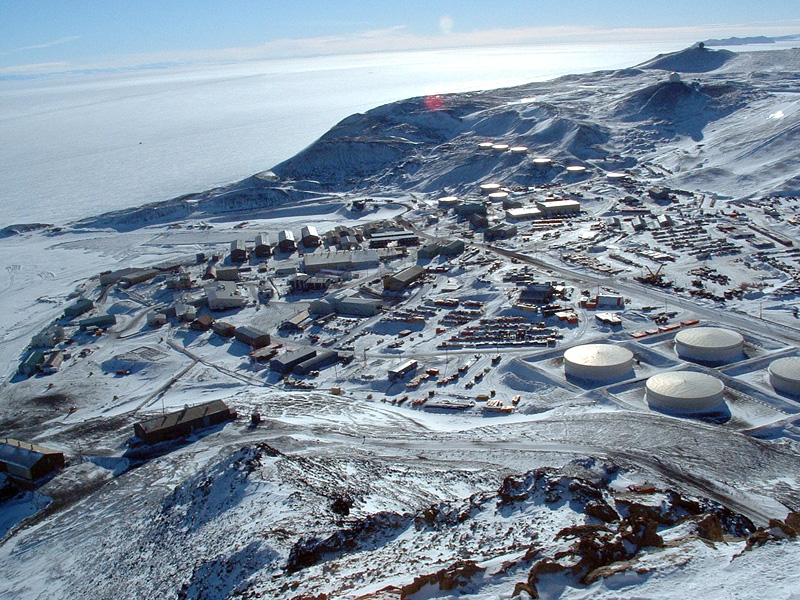
More Antarctic Webcams NOTE: Webcam images are often obscured due to harsh and unpredictable weather conditions. McMurdo Station (77°51'S, 166°40'E), the main U.S. station in Antarctica, is a coastal station at the southern tip of Ross Island, about 3,864 km (2,415 miles) south of Christchurch, New Zealand, and 1,360 km (850 miles) north of the South Pole. The original station was built in 1955 to 1956 for the International Geophysical Year. Today's station is the primary logistics facility for supply of inland stations and remote field camps, and is also the waste management center for much of the U.S. Antarctic Program. Year-round and summer science projects are supported at McMurdo. The station has a harbor, landing strips on the ice shelf and a helicopter pad. The two airfields-Phoenix and Williams Field Skiway-are used by different aircraft. Repair facilities, dormitories, administrative buildings, a firehouse, power plant, water distillation plant, wharf, stores, clubs, warehouses, a science support center, and the first-class, 4,320 square-meter Crary Lab are linked by above-ground water, sewer, telephone, and power lines. Additional Links and Resources The mean annual temperature is -18°C (0°F). Temperatures may reach 8°C (46°F) in summer and -50°C (-58°F) in winter. The average wind is 12 knots, but winds have exceeded 100 knots. Research in multiple fields is performed at and near McMurdo Station, including Astrophysics and Geospace Sciences, Earth Sciences, Glaciology, Integrated System Science, Ocean and Atmospheric Sciences, and Organisms and Ecosystems. Participants of the Antarctic Artists and Writers Program also work at sites in the area. For information about projects supported at McMurdo Station--and based from McMurdo, such as deep field projects in East and West Antarctica--see the USAP Science Planning Summaries on the Science Support page. Historical information on previous seasons can be found at the Science Planning Summaries Archives. To find out more about life at U.S. Antarctic research stations, see the Around the Continent section of The Antarctic Sun. |
||||||||||||
McMurdo Station Webcams



For USAP Participants |
For The Public |
For Researchers and EducatorsContact UsU.S. National Science FoundationOffice of Polar Programs Geosciences Directorate 2415 Eisenhower Avenue, Suite W7100 Alexandria, VA 22314 Sign up for the NSF Office of Polar Programs newsletter and events. Feedback Form |