|
Deep channels link ocean to Antarctic glacier 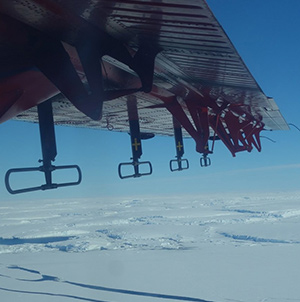
National Science Foundation Posted September 10, 2020 A view of Thwaites Glacier from a BAS Twin Otter aircraft in January 2020. Credit: Carl Robinson Newly discovered deep seabed channels beneath Thwaites Glacier in West Antarctica may be the pathway for warm ocean water to melt the underside of the ice. Data from two research missions, using aircraft and ship, are helping scientists to understand the contribution this huge and remote glacier is likely to make to future global sea-level rise. Researchers from UK and US International Thwaites Glacier Collaboration (ITGC), collected data from the glacier and adjoining Dotson and Crosson ice shelves during January-March 2019. While one team collected airborne data flying over the glacier and ice shelf in a British Antarctic Survey Twin Otter aircraft, the other mapped the seafloor at the ice front from the US Antarctic Program icebreaker RV Nathaniel B Palmer. Publishing this month (9 September) in the journal The Cryosphere, the two research papers describe the discovery. Thwaites Glacier covers 192,000 square kilometers (74,000 square miles) - the size of Great Britain or the US state of Florida – and is particularly susceptible to climate and ocean changes. Read more: https://bit.ly/2DPc4Ck
|


For USAP Participants |
For The Public |
For Researchers and EducatorsContact UsU.S. National Science FoundationOffice of Polar Programs Geosciences Directorate Randolph Building 401 Dulany Street Alexandria, VA 22314 Sign up for the NSF Office of Polar Programs newsletter and events. Feedback Form |