|
Hidden River Once Flowed Beneath Antarctic Ice 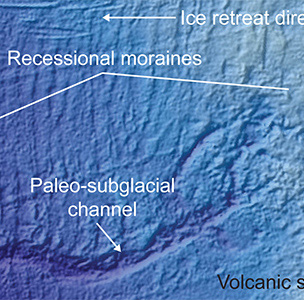
National Science Foundation Posted August 25, 2017 Image credit: Lindsay Prothro, Rice University NSF funded Antarctic researchers from Rice University have discovered that flowing liquid water below the ice appears to play a pivotal role in determining the fate of Antarctic ice streams. The finding, which appeared online in the journal Nature Geoscience, follows a two-year analysis of sediment cores and precise seafloor maps covering 2,700 square miles of the western Ross Sea. As recently as 15,000 years ago, the area was covered by thick ice that later retreated hundreds of miles inland to its current location. The maps, which were created from state-of-the-art sonar data collected by OPP’s research vessel, the Nathaniel B. Palmer, revealed how the ice retreated during a period of global warming after Earth's last ice age. In several places, the maps show ancient water courses -- not just a river system, but also the subglacial lakes that fed it. The research was supported by NSF and the Swedish Research Council. Researchers from Stockholms universitet (Stockholm University), UMass Amherst, The University of Kansas, and Penn State co-authored the paper. Today, Antarctica is covered by ice that is in some places more than 2 miles thick. Though deep, the ice is not static. Gravity compresses the ice, and it moves under its own weight, creating rivers of ice that flow to the sea. Even with the best modern instruments, the undersides of these massive ice streams are rarely accessible to direct observation. “The contemporary observations we have of Antarctic hydrology are recent, spanning maybe a couple decades at best,” said Rice postdoctoral researcher Lauren Simkins, lead author of the new study. “This is the first observation of an extensive, uncovered, water-carved channel that is connected to both subglacial lakes on the upstream end and the ice margin on the downstream end. This gives a novel perspective on channelized drainage beneath Antarctic ice. We can track the drainage system all the way back to its source, these subglacial lakes, and then to its ultimate fate at the grounding line, where freshwater mixed with ocean water.” Read more in a Rice University new release here: http://news.rice.edu/2017/08/21/hidden-river-once-flowed-beneath-antarctic-ice-2/
|



For USAP Participants |
For The Public |
For Researchers and EducatorsContact UsU.S. National Science FoundationOffice of Polar Programs Geosciences Directorate Randolph Building 401 Dulany Street Alexandria, VA 22314 Sign up for the NSF Office of Polar Programs newsletter and events. Feedback Form |