|
The Ice Detectives 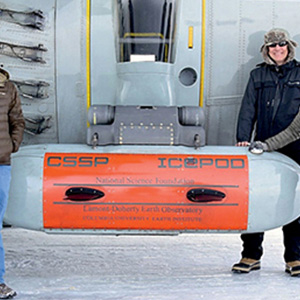
National Science Foundation Posted September 13, 2017 Columbia Magazine, published by Columbia University in the City of New York, features a story that focusses on the work of NSF funded researchers, such as Columbia’s Robin E. Bell, and projects such as IcePod, a collaborative effort with the 109th Airlift Wing, in trying to predict the fate of the Earth’s polar ice sheets. “... Today, earth’s great ice sheets sprawl over Antarctica and Greenland, the vast, sliding bodies polished by the harshest conditions on the planet, layered with millennia of snowfall packed more than two miles thick in spots: a colossal architecture moving constantly under its own weight, sloping toward the sea. Robin Bell ’89GSAS is watching. Bell, a geophysicist at Columbia's Lamont-Doherty Earth Observatory and one of the world’s leading polar investigators, has been tracking ice for thirty years: inspecting it, measuring it, drilling it, flying over it, spying under it, peering through its layers, sleeping on it, skiing on it. She has coordinated ten expeditions to Antarctica and Greenland, which between them hold more than 99 percent of the world’s frozen fresh water. That ice is transforming before her eyes. “There are three lines of evidence that the ice sheets are changing,” Bell says. “One: in some places they are flowing twice as fast as they were twenty years ago — a mile a year in the last decade, two miles a year now. Two: their elevation has dropped. Three: they are losing mass, which we can tell from satellite measurements.” Designed and built with grant money from the National Science Foundation (NSF), IcePod is rigged with conventional and infrared cameras adapted for ice use by Lamont-Doherty Earth Observatory oceanographer Chris Zappa ’92SEAS (the infrared cameras can detect unseen cracks, or crevasses, by measuring tiny variances in ground temperature); shallow- and deep-ice radar built by Nick Frearson, IcePod’s lead engineer; a scanning laser to create 3D images of the ice surface; and a magnetometer to measure the earth’s magnetic field.” Read more here: http://magazine.columbia.edu/features/fall-2017/ice-detectives?page=0,0
|


For USAP Participants |
For The Public |
For Researchers and EducatorsContact UsU.S. National Science FoundationOffice of Polar Programs Geosciences Directorate Randolph Building 401 Dulany Street Alexandria, VA 22314 Sign up for the NSF Office of Polar Programs newsletter and events. Feedback Form |