2026-2027 USAP Field Season
Project Detail Project TitleCAREER: Coastal Antarctic Snow Algae and Light Absorbing Particles: Snowmelt, Climate, and Ecosystem Impacts Summary
Event Number:
Program Director:
ASC POC/Implementer: Principal Investigator(s)
Dr. Alia Lauren Khan
Project Web Site: Location
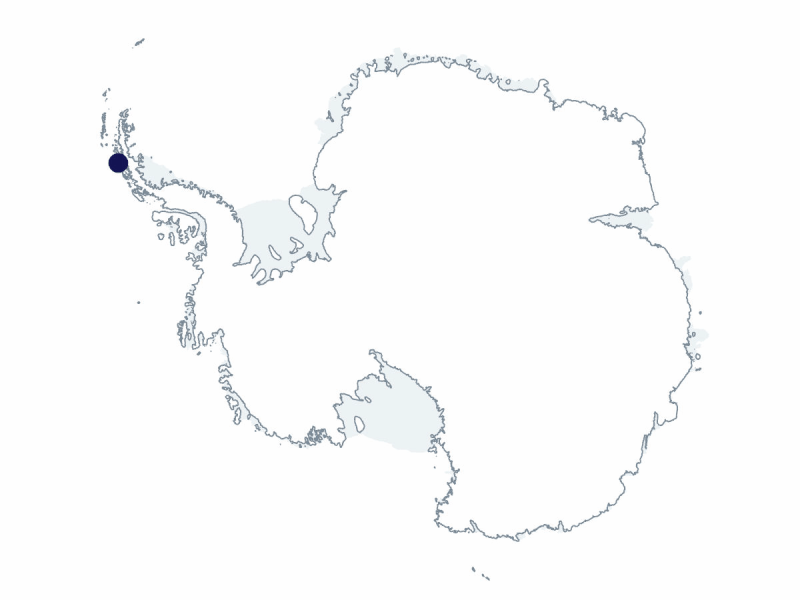
Supporting Stations: Palmer Station DescriptionThis 5-year, time series project will assess the effects of changing cryosphere-albedo feedback in the Antarctic Peninsula and the Pacific Northwest. A variety of in situ and remote sensing data collected across multiple spatial scales will be used to evaluate the role of temperature, radiative forcing effects, and light absorbing particles (LAPs) on snow algae growth. The project is expected to advance knowledge of factors that affect the snow algae growing season. Ground measurements will inform development and application of novel algorithms to map algal bloom extent through time using multispectral satellite imagery at 0.5- to 3.0-meter spatial resolution. These results will be used to improve snow algae parameterization in a new version of the Snow Ice Aerosol Radiation (SNICARv3) model that includes bio-albedo feedbacks, eventually informing models of ice-free area expansion through incorporation of SNICARv3 in the Community Earth System Model. Local Pacific Northwest sites will be used to develop educational case studies in classroom and field courses and for URM-targeted graduate student education and for middle school snow camp. Field Season OverviewTwo field team members will deploy to Palmer Station in 2026-27. Sampling sites at Palmer will be identified at the start of the season, with sampling variously taking place weekly (at areas easily accessed from Palmer), every other week (at areas further afield accessed via Zodiac inflatable boat) and every ~3 weeks (at areas accessed via longer Zodiac trips). Sampling at all locations will include taking snow samples and physical and spectral reflective measurements to determine the spatial and temporal distribution of snow algae. Additional physical properties will be measured (e.g., snow depth, density, grain size). The science team’s principal investigator (PI) will take spectral reflectance measurements with an Analytical Spectral Devices FieldSpec 4 hyperspectral spectroradiometer. At certain identified sample sites, the PI will install a time-lapse camera, snow depth sensor, and air temperature sensors. The team will also deploy an uncrewed aerial system, which will require a separate PI-generated concept of operations when flown at Palmer Station. Samples will either be analyzed at Palmer Station or fixed and shipped to the PI's home university. Deploying Team Members
|
2026-2027 Science Planning Summary


For USAP Participants |
For The Public |
For Researchers and EducatorsContact UsU.S. National Science FoundationOffice of Polar Programs Geosciences Directorate Randolph Building 401 Dulany Street Alexandria, VA 22314 Sign up for the NSF Office of Polar Programs newsletter and events. Feedback Form |