2026-2027 USAP Field Season
Project Detail Project TitleImaging the Beginning of Time From the South Pole: Completing the BICEP Array Survey Summary
Event Number:
Program Director:
ASC POC/Implementer: Principal Investigator(s)
Dr. Clement Pryke
Project Web Site: Location
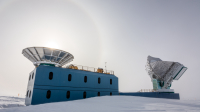
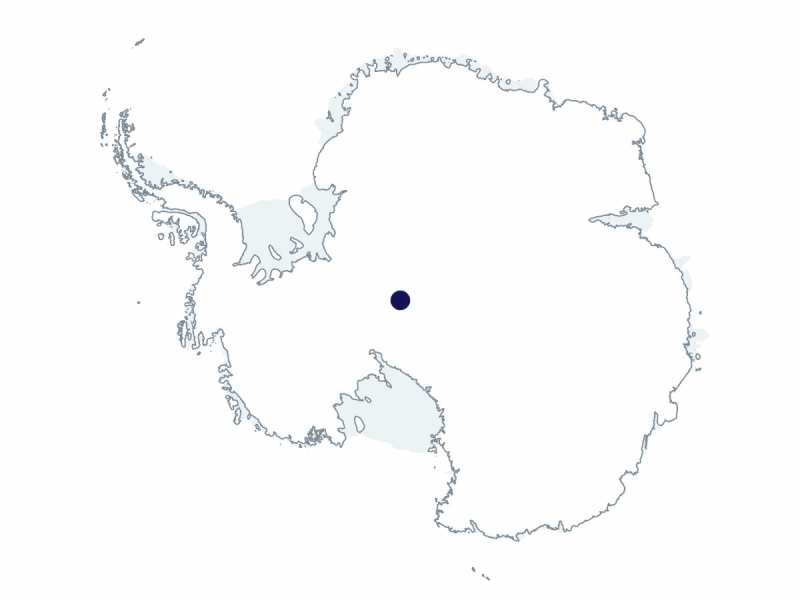
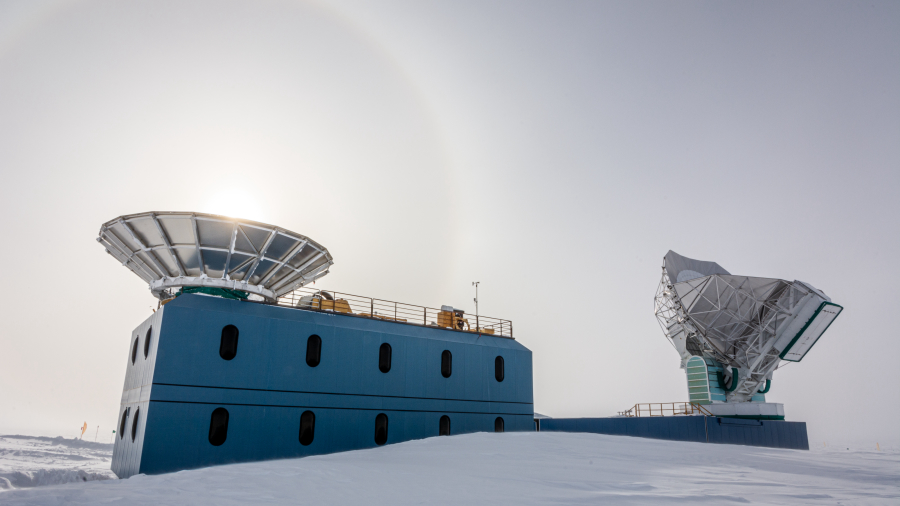
Supporting Stations: South Pole Station DescriptionThis project continues the Background Imaging of Cosmic Extragalactic Polarization (BICEP) research program measuring polarization of the cosmic microwave background (CMB). These observations include operation of the BICEP3 stand-alone telescope, as well as the phased installation of the new BICEP Array receivers. The sustained campaign at 95 gigahertz (GHz) enables the project’s dataset to build sensitivity at frequencies where the contribution from galactic dust is lower and the signal from the CMB is strongest. In October 2021 the science team published its analysis of all data taken by the BICEP2, Keck array, and BICEP3 experiments, up to and including the 2018 observing season. This result remains the best in the field, reaching a sensitivity to inflationary gravitational waves of sigma(r) = 0.009. Currently, BICEP3 and the BICEP array are measuring the sky in five frequency bands to enable the removal of galactic foreground contamination. Extrapolating from achieved performance, and after conservatively accounting for the galactic dust, galactic synchrotron, and gravitational lensing foregrounds, the BICEP array is expected to reach a sensitivity of sigma(r) < 0.003. This measurement will be a critical test of slow-roll models of inflation, many of which predict a gravitational wave signal at or above this level. This project also provides training for undergraduate and graduate students and postdoctoral fellows. It represents an intersection of cosmology and Antarctic research that continues to stimulate the public imagination and interest in science. Field Season OverviewPrimary tasking for 2026-27 will be deploying the fourth BICEP array receiver (BA4-90/150), including assembly and in-lab characterization, installation, and in-mount characterization checkouts. The science team will also perform (1) detector module upgrades to the third BICEP array receiver (BA3-220/270), operating at 220-270 GHz; (2) maintenance and minor upgrades to the BICEP3, BA1-30/40, and BA2-150 receivers; (3) removal of the Keck 270 receiver from the BICEP array mount, disassembly, and retrograde of receiver hardware and accessories; (4) winter-over training to allow continued observations with BICEP3 and the BICEP array during the 2027 austral winter season; and (5) standard on-mount calibration activities with the BICEP3 and BICEP array receivers. Deploying Team Members
|
2026-2027 Science Planning Summary



For USAP Participants |
For The Public |
For Researchers and EducatorsContact UsU.S. National Science FoundationOffice of Polar Programs Geosciences Directorate Randolph Building 401 Dulany Street Alexandria, VA 22314 Sign up for the NSF Office of Polar Programs newsletter and events. Feedback Form |