2026-2027 USAP Field Season
Project Detail Project TitleFormation, Transformation, and Northward Spread of Dense Saline Water Derived From Terra Nova Bay, Ross Sea, Antarctica Summary
Event Number:
Program Director:
ASC POC/Implementer: Principal Investigator(s)
Dr. Christopher J Zappa
Location
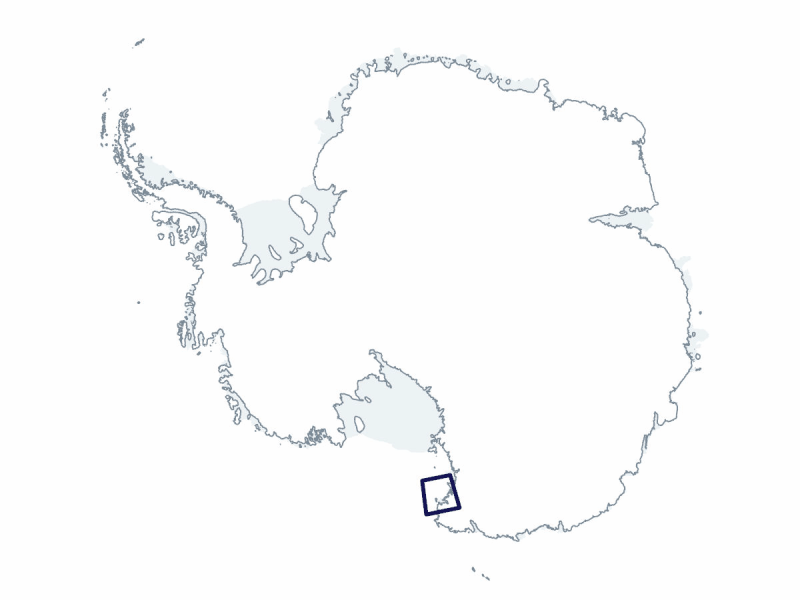
Supporting Stations: Special Project DescriptionThis project primarily aims to investigate the formation, transformation, and northward spread of dense saline water derived from Terra Nova Bay (TNB), along the Drygalski Trough into the western Ross Sea and off the ice shelf to the Southern Ocean, to form the Antarctic bottom water. The project will deploy a series of moorings: two heavily instrumented full-water-column moorings within TNB to capture high-salinity shelf water (HSSW) production; and a series of bottom-focused moorings to evaluate the transformation and northward spreading of the dense saline water. The broad science goals to be addressed by this program through a coordinated analysis of these mooring measurements include (1) how the water column profile and HSSW characteristics evolve on timescales ranging from hourly/daily through seasonal; and (2) what regulates the transformation and northward spread of the dense saline water derived in TNB. This project involves international cooperation between the US, South Korea, New Zealand (NZ), and Italy. Field Season OverviewThis project sees oceanographic moorings deployed and recovered across 3 years, including two heavy moorings (instrumented from the ocean floor to 50 meters [m] beneath the ocean surface in water depths of roughly 400-500 m and 800-1000 m) deployed in TNB and four deep bottom moorings (instrumented within the bottom 10-100 m of the seafloor). One deep bottom mooring will be deployed in the Drygalski Basin in TNB, one near Cape Washington in the northern extent of TNB, and two along the Drygalski Trough, further north in the Ross Sea toward Cape Adare. In the 2026-27 season, the science team will recover the two heavy moorings and four deep bottom moorings with support from the Korean Polar Research Institute (KOPRI) aboard the research vessel (RV) Araon. The team will also deploy four low-profile moorings to be retrieved by Italian, NZ, and Korean Antarctic programs. The United States Antarctic Program will assist with moving cargo and personnel between the ports of departure and arrival of the RV Araon and storing equipment in NZ between seasons. Deploying Team Members
|
2026-2027 Science Planning Summary


For USAP Participants |
For The Public |
For Researchers and EducatorsContact UsU.S. National Science FoundationOffice of Polar Programs Geosciences Directorate Randolph Building 401 Dulany Street Alexandria, VA 22314 Sign up for the NSF Office of Polar Programs newsletter and events. Feedback Form |