2026-2027 USAP Field Season
Project Detail Project TitlePayload Antarctic Demonstrator for the Advanced Particle-astrophysics Telescope (ADAPT) Summary
Event Number:
Program Director:
ASC POC/Implementer: Principal Investigator(s)
Dr. James Henry Buckley
Project Web Site: Location
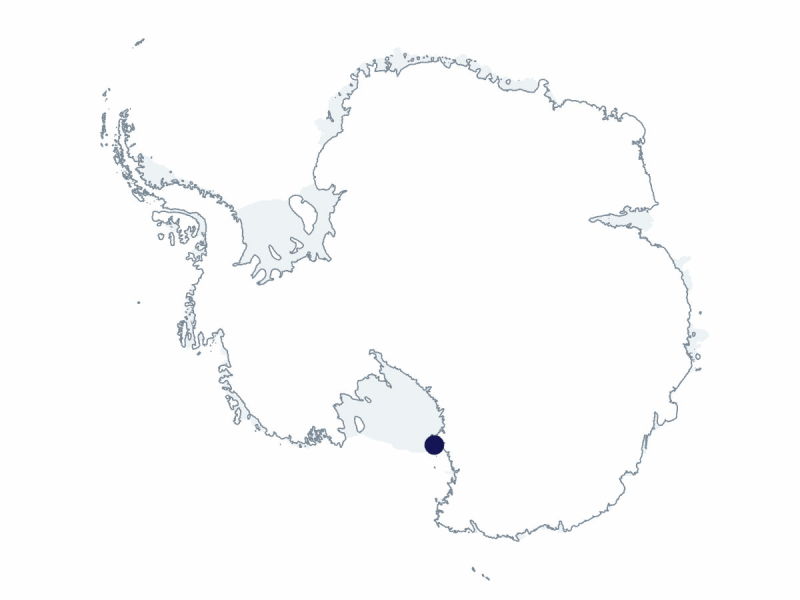
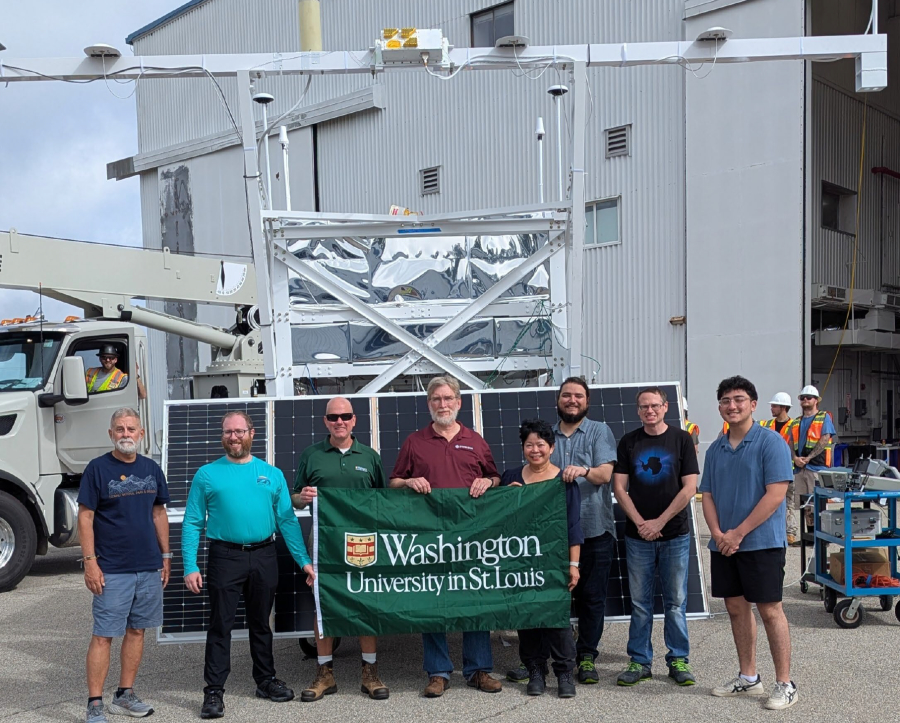
Supporting Stations: McMurdo Station DescriptionThe Antarctic Demonstrator for the Advanced Particle-astrophysics Telescope (ADAPT) is primarily a technical demonstrator for a future space-based gamma ray experiment, the Advanced Particle-astrophysics Telescope (APT). APT will provide the most sensitive measurements of the MeV to 100 MeV gamma ray sky for any astrophysical transients during its flight. The APT’s long-term goals include (1) detecting or ruling out weakly interacting massive particle (WIMP) dark matter; (2) providing electromagnetic counterparts of gravitational wave or other multi-messenger sources, and (3) understanding the origin of the heavy elements. ADAPT will carry two piggyback payloads: Air Shower Extended Simulations (AIRES), designed to analyze the radio pulses emitted by cosmic rays interacting with Earth's atmosphere; and Integrating Miniature Piggyback for Impulsive Solar Hard X-rays (IMPISH), a solar X-ray spectrometer measuring energy fluctuations during solar flares. The ADAPT experiment will fly the ADAPT gondola on a 39 million cubic foot (mcf) balloon at the Long Duration Balloon Facility (LDBF) in Antarctica. ADAPT is a 0.5-by-0.5-meter active area telescope for mega-electronvolt (MeV) and giga-electronvolt (GeV) gamma ray detection and cosmic ray measurements. The instrument makes use of scintillating fibers, cesium iodide scintillators, and custom electronics to detect and reconstruct gamma rays through Compton imaging (in the MeV regime) and pair tracking and calorimetry (in the GeV regime). Real-time onboard computation will be used to localize gamma ray bursts and promptly transmit alerts to the ground. Field Season OverviewField support required for ADAPT in 2026-27 includes hosting scientists at McMurdo Station (with an office in Albert P. Crary Science and Engineering Center), transportation to the LDBF, and space in one of the two LDBF hangers. Crane operations will also be required to install the detector, solar panel, and antenna boom on the instrument. To satisfy science requirements, ADAPT is aiming for a long (30-day) flight at high altitude to maximize chances for detecting and localizing several gamma ray bursts. The plan is to deploy nine science team members to Antarctica for the flight and approve two to recover the flight computer, data, and piggyback experiments in 2027. The science team is slated to arrive in McMurdo around 3 November 2026 and anticipates no more than 23 days (and possibly many fewer) to prepare for a 30 November launch. The target float altitude is approximately 135 kilofeet, the maximum for a 39 mcf balloon. The minimum flight duration for success is 10 days, while the maximum flight duration would be 50 days, subject to prospects for payload recovery and operational status during the flight. Same-season payload recovery via aircraft, Arctic Trucks, or traverse is requested. Deploying Team Members
|
2026-2027 Science Planning Summary



For USAP Participants |
For The Public |
For Researchers and EducatorsContact UsU.S. National Science FoundationOffice of Polar Programs Geosciences Directorate Randolph Building 401 Dulany Street Alexandria, VA 22314 Sign up for the NSF Office of Polar Programs newsletter and events. Feedback Form |