2026-2027 USAP Field Season
Project Detail Project TitleCollaborative Research: RAPID: Antarctic Groundwater-Ecosystem Connectivity Across Ice-Ocean-Land Critical Zones Summary
Event Number:
Program Director:
ASC POC/Implementer: Principal Investigator(s)
Dr. Jill Mikucki
Location
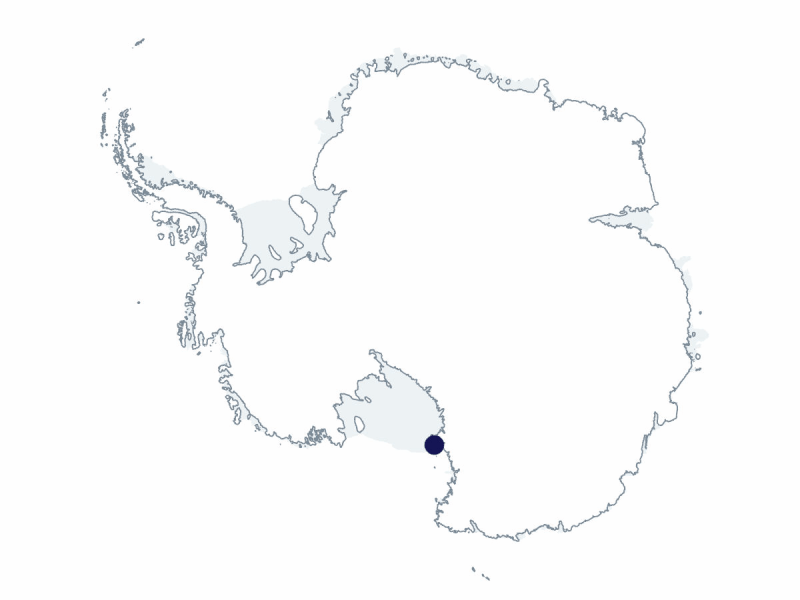
Supporting Stations: McMurdo Station DescriptionAntarctica holds vast, hidden reservoirs of salty groundwater beneath its ice and frozen soils; an extensive network that may influence ocean ecosystems and ice sheet stability. This project will directly measure groundwater discharge and potential associated gas seeps along the Antarctic coast, revealing how these subsurface waters transport nutrients, trace metals, microorganisms, and gases to the Southern Ocean. Understanding these exchanges is vital because they can shape marine productivity, influence carbon cycling, and control the release or storage of gases. The project strengthens US and New Zealand scientific collaboration in alignment with the “Antarctica InSync” initiative, supporting coordinated, sustainable research in one of the world’s most logistically challenging environments. Insights from this work will help improve predictions of how Antarctica both responds to and influences global environmental change. This collaborative RAPID project investigates how Antarctic groundwater drives ecosystem connectivity across the McMurdo Sound coastal zone. The science team will identify groundwater discharge using in situ gamma radiation sensors, deploy seepage meters and OsmoSamplers for fluid and gas flux measurements, and collect water and sediment samples for detailed geochemical and microbial analyses. Data from this project will quantify groundwater pathways, flux rates, and biogeochemical properties. The project tests the hypothesis that Antarctic groundwater significantly affects coastal geochemistry, microbial diversity, and glacial flow, influencing the sensitivity of Antarctic coastal margins to dynamics. The findings will provide foundational data for future multinational monitoring, modeling, and management of Antarctic critical zones. Field Season OverviewThis is a collaborative event between the United States Antarctic Program (USAP) and Antarctica New Zealand (AntNZ), with the majority of on-continent support provided by AntNZ. Three USAP and six AntNZ participants will deploy in mid-October 2026 to Scott Base, where they will conduct preparations before putting into their field sites. Field work will involve measuring and sampling Antarctic groundwater discharge and gas-rich seeps along the McMurdo Sound coast at Cape Evans and in the New Harbor area. Groundwater presence will be assessed by measuring gamma radiation tracers of groundwater flux via an in situ radionuclide detector. The team will work out of the AntNZ camp at Cape Evans for approximately 2 weeks then the USAP New Harbor fixed camp for about 2 weeks (with a backup site at Cinder Cones). Visits to the USAP Lake Bonney fixed camp (four participants for about 1 week) and USAP Lake Fryxell fixed camp as secondary groundwater flux sites are also planned. Seepage meters will be deployed at Cape Evans and New Harbor, which will require diving to install and retrieve. Antarctic Support Contract dive staff will assist with diving work. Deployment of instruments, water column profiling with a multimeter sonde and gamma radiation sensor, and sample collection will require access holes in the sea ice and the potential use of USAP resources. Lab space in Albert P. Crary Science and Engineering Center will be required for field preparation and sample processing. Participants will return to Scott Base in early December 2026 and redeploy by mid-December 2026. Deploying Team Members
|
2026-2027 Science Planning Summary


For USAP Participants |
For The Public |
For Researchers and EducatorsContact UsU.S. National Science FoundationOffice of Polar Programs Geosciences Directorate Randolph Building 401 Dulany Street Alexandria, VA 22314 Sign up for the NSF Office of Polar Programs newsletter and events. Feedback Form |