2026-2027 USAP Field Season
Project Detail Project TitleNext Generation of Geospace Research Facilities at USAP Stations Summary
Event Number:
Program Director:
ASC POC/Implementer: Principal Investigator(s)
Dr. Hyomin Kim
Location
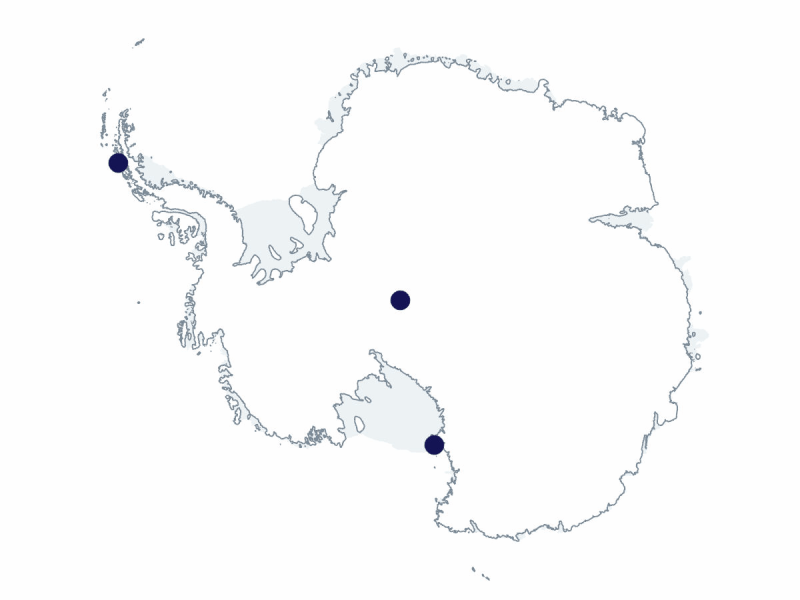
Supporting Stations: McMurdo Station, Palmer Station, South Pole Station DescriptionEarth’s space environment (geospace) is important to understanding the planet’s functions within the solar system and the Sun’s influence via space weather on technological systems on Earth and in space. Space weather impacts a wide range of technologies, including spacecraft operations and orbits, global positioning systems (GPSs), global navigation satellite systems, high-frequency radio communications, and power grids. Earth’s polar caps are specific areas around the geomagnetic poles where geomagnetic field lines are open to and directly interact with the interplanetary magnetic field. Consequently, Antarctica is an ideal location for geospace research, as its land mass provides superior siting to observe the Earth’s high geomagnetic latitude magnetic field lines, thereby facilitating studies of the polar cap, cusp, auroral zone, and geosynchronous altitude where communications satellites orbit and allowing for extended and continuous observations of the Sun. As such, Antarctic stations have long been outfitted with a variety of instrumentation for observational studies of the geospace environment. This project integrates clustered instrumentation at McMurdo Station, South Pole Station, and Palmer Station to examine the entire geospace system. Instruments include ground-based fluxgate and search- coil magnetometers, extremely low, very low, and high frequency receivers, imaging and broadband riometers, sky-looking optical systems, GPS scintillation-rated receivers, and more. The project expects to modernize the geospace science instruments at both stations. The fieldwork will (1) assess the current geospace instrumentation at McMurdo Station, South Pole Station, and Palmer Station; (2) overhaul and/or replace existing instruments; (3) continue operation, collection, and dissemination of a host of data types; and (4) continue the coordinated logistical support approach of managing a diverse network of instruments at a single point of contact: the New Jersey Institute of Technology - Polar Engineering Development Center. Field Season OverviewDuring the 2026-27 season, a science team of four will deploy to McMurdo Station, and a team of two will deploy to South Pole Station. The teams will service equipment; perform calibrations, repairs, and replacements; and decommission obsolete and non-functioning equipment. No on-site fieldwork will be performed at Palmer Station. The instruments will continue operating autonomously year-round via remote monitoring and control, aided by on-site support from Antarctic Support Contract staff and other station infrastructure (e.g., information technology network, station services) as needed. Research associates (RAs) will carry out a prescribed set of support tasks as described in standard operating procedures that the principal investigators (PIs) will provide. Typical RA services include swap-outs and shipping of data devices, rebooting systems as needed, and, to a limited extent, assisting PIs with troubleshooting as needed. Deploying Team Members
|
2026-2027 Science Planning Summary



For USAP Participants |
For The Public |
For Researchers and EducatorsContact UsU.S. National Science FoundationOffice of Polar Programs Geosciences Directorate Randolph Building 401 Dulany Street Alexandria, VA 22314 Sign up for the NSF Office of Polar Programs newsletter and events. Feedback Form |